As we move into the middle and late summer, we should consider the moisture requirements of our landscape plants. Trees differ from typical herbaceous plants with deeper roots and different watering requirements. Let’s review best practices for determining when to water and some options available for providing supplemental watering during hot dry summer conditions.
How To Know When To Water
With the sun beating down and the feeling of chapped lips, it may be instinctive to start hosing down everything in your garden, assuming they need water. However, sometimes we need to take a more empirical approach to deciding when and when not to apply supplemental water.
Consider when it last rained. If rainfall occurred a day or two prior, it may be unnecessary to add additional water to your landscape trees. A significant rain event delivering 1-2 inches of water should keep your mature trees hydrated for at least 1 week and newly planted trees for a few days. However, a quick smattering of less than an inch is not going to saturate the soil enough to hydrate your trees. That’s why we recommend checking if you’re unsure. Spring is typically full of rain events for us in the Midwest, but we should be considering watering needs for our landscape trees and shrubs through summer and fall. We don’t want these plants going into harsh dry winter months without any moisture in the ground, so make sure you’re still checking for watering needs until regular freezing temps set in.
The ideal time of day to water your trees and shrubs is during the early morning or evening hours. During these cooler parts of the day, there is less evaporation loss compared to the heat of midday. This means more water reaches the tree roots rather than evaporating into the air.
How To Check Soil Moisture Content
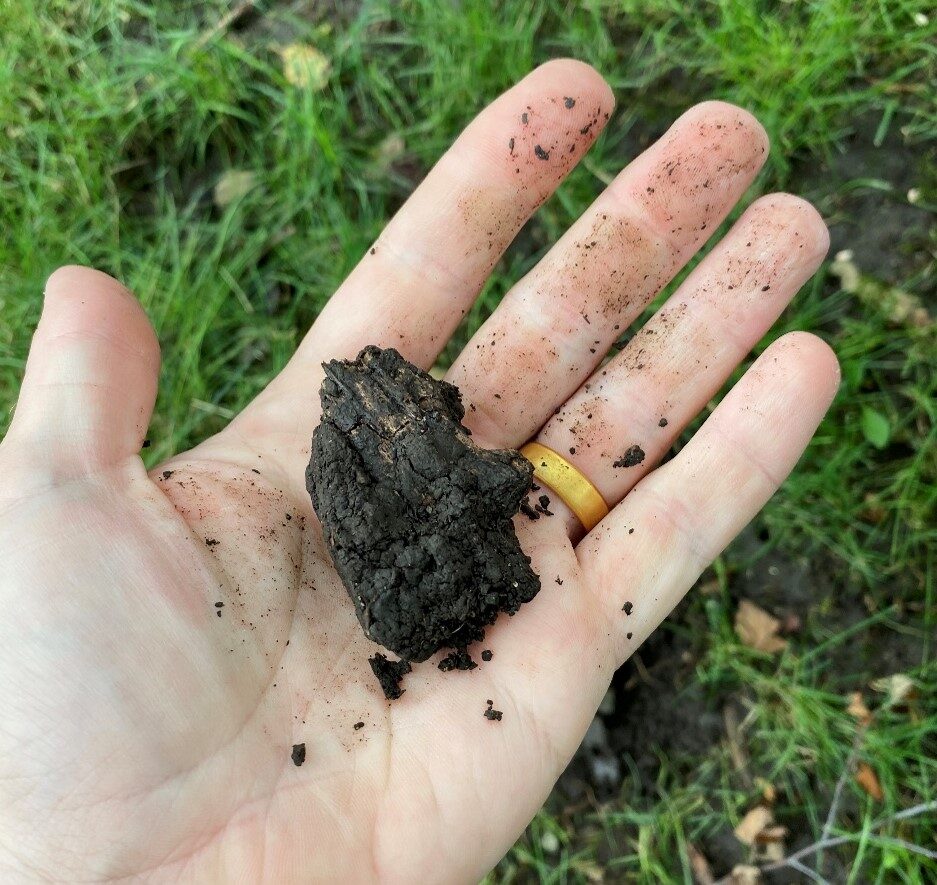
The simple tried and true method is sticking a finger into the soil and feeling how hard the crust is and how damp the soil under the crust feels. If it’s crumbly and looks very rough, then you should probably apply supplementary water. If it’s very damp, and you can get a finger into the soil without much resistance, you may not need to water for another couple of days. If you can take some soil in your hand and form it into a clump that doesn’t crumble apart, then the soil is certainly wet enough. Check again after a few more days of hot dry conditions.
Soil moisture meters are also readily available and can give you a more direct measurement of soil moisture content. These devices usually have a dial that will read either in green indicating adequate moisture or yellow/red for dry. Some devices may only give a numerical value. Read the instruction manual for your meter and follow it closely to ensure proper reading and interpretation. For measuring soil moisture content for a tree, get a moisture meter that can read at least 6-inch depth.
How Much Water Does My Tree Need and How Do I Apply It?
A simple rule of thumb is 1 to 1.5 gallons of water per inch of trunk diameter. So, a 10″ diameter tree may need 10-15 gallons of supplemental water applied. In hot dry conditions, it’s best to stay closer to the high end of that rule. We use DBH or Diameter at Breast Height to measure trunk size, which is measured at about 4.5 feet above soil level. There are commercial measuring tools for this purpose, but a simple low-tech way to get this measurement is to wrap a string around the trunk and measure the string length. Divide the length of the string by 3.14 to convert the circumference into diameter, and you’ve got the DBH of the trunk.
In general, we want to water with a deep soak and less frequently than regular shallow watering. A sprinkler running for 5 minutes is great for turf grass but won’t do a tree in your landscape any good. Trees need a deep soaking watering that hydrates all the roots with moisture. This will encourage the tree to grow roots more deeply rather than remaining very shallow in the soil. Providing this supplemental watering at least once a week for established trees and 2-3 times a week for newly planted trees will help them look their best and stay healthier.
So, we’ve established the supplemental watering needs for trees in our landscape. Now how do we apply that supplemental water to the tree?
Many irrigation options are available commercially. Some can run automatically, cover a pre-determined area of your landscape, and even operate at the best times of the day. We won’t cover every possible product and configuration here. Let’s just cover a couple of the simplest ways to water your tree which require minimal additional tools or equipment.
The Simplest Method: Garden Hose Watering
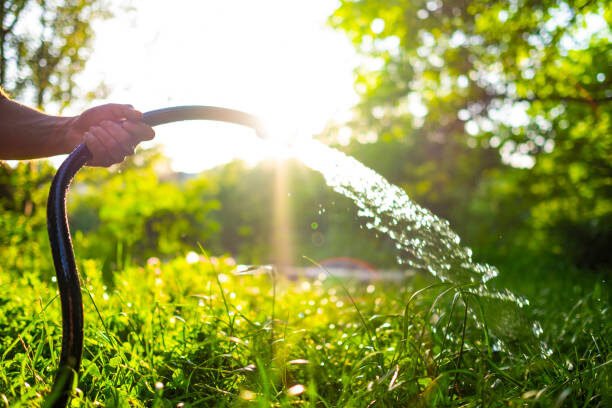
This technique is exactly what it sounds like. Place a garden hose next to the base of the tree’s trunk and allow it to run and apply water to the soil. To water a tree, run the hose at a slow trickle instead of a fast rush of water. The soil should be absorbing the water. If you see water sheeting off and away, then the hose valve is open too much. Close it off until you have a slower pace running out of the hose. Your goal is to saturate the soil near the base of the trunk around the full circumference of the tree. Avoid spraying water onto the trunk or the foliage; this will not water the roots and instead may encourage fungal disease and decay.
For garden hose watering, we recommend running the hose at a trickle for about 15-20 minutes at a time and re-positioning the hose at least 4 times around the base of the tree. Divide the trunk into quadrants and ensure each quadrant gets saturated by watering. If the trunk circumference is too large for 4 spots to saturate sufficiently, then move the hose more times to cover the larger area. Maybe your tree needs 6 spots watered, or 8. Use your best judgment. Going a little over the watering requirement is preferable to going under, but we don’t want to create a pool of standing water.
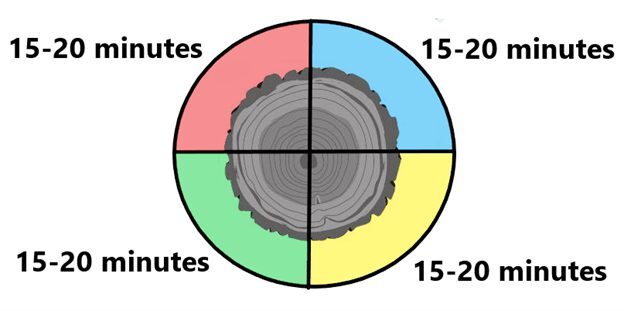
The goal is to distribute water evenly around the base of the trunk. This area is particularly dense with feeder roots and will absorb water most effectively.
If you want to be more technical, you could measure how much water is running from your hose by timing how long it takes to fill a 5-gallon bucket. This can help give you an idea of how much time may be necessary to water each location around the base of the trunk. In other words, if you measure 2.5 gallons of water leaving the hose per 10 minutes, then you should water your 10″ diameter tree for at least 40 minutes to achieve the 1 gallon per inch rule described earlier. That 10 gallons can be applied evenly by relocating the hose 4 times for 10 minutes at each spot.
The Second Simplest Method: Bucket Watering
5-gallon buckets are a common household item and can help you more precisely water your trees. If you want to make sure you’re applying the exact right amount of water without going too far over, this may be the method for you.
Take any basic 5-gallon bucket and be sure it’s clean and clear of any debris on the inside. Do not reuse any bucket that may have previously contained any substance that may be hazardous to plant life. A clean unused bucket may also be purchased from local hardware stores.
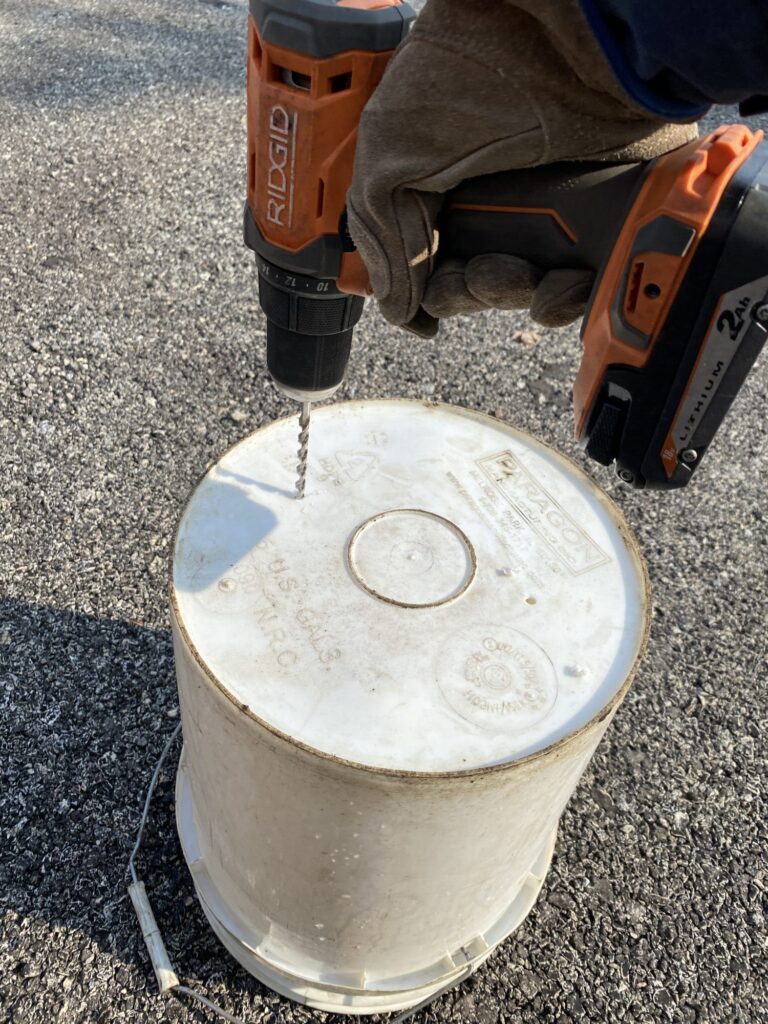
The method is simple: drill 2 or 3 holes into the bottom of the bucket. We don’t want anything larger than 1/8 inch in diameter for our drain holes. Larger holes will allow too much water to escape too quickly and won’t saturate the soil as slowly as we want. They should be small enough to allow a good trickle but not fast draining. Once you have the bucket ready it’s as simple as filling the bucket and allowing it to drain out. You can relocate the bucket to a different area of the base of the trunk and repeat as many times as necessary. For smaller trees, use smaller buckets.
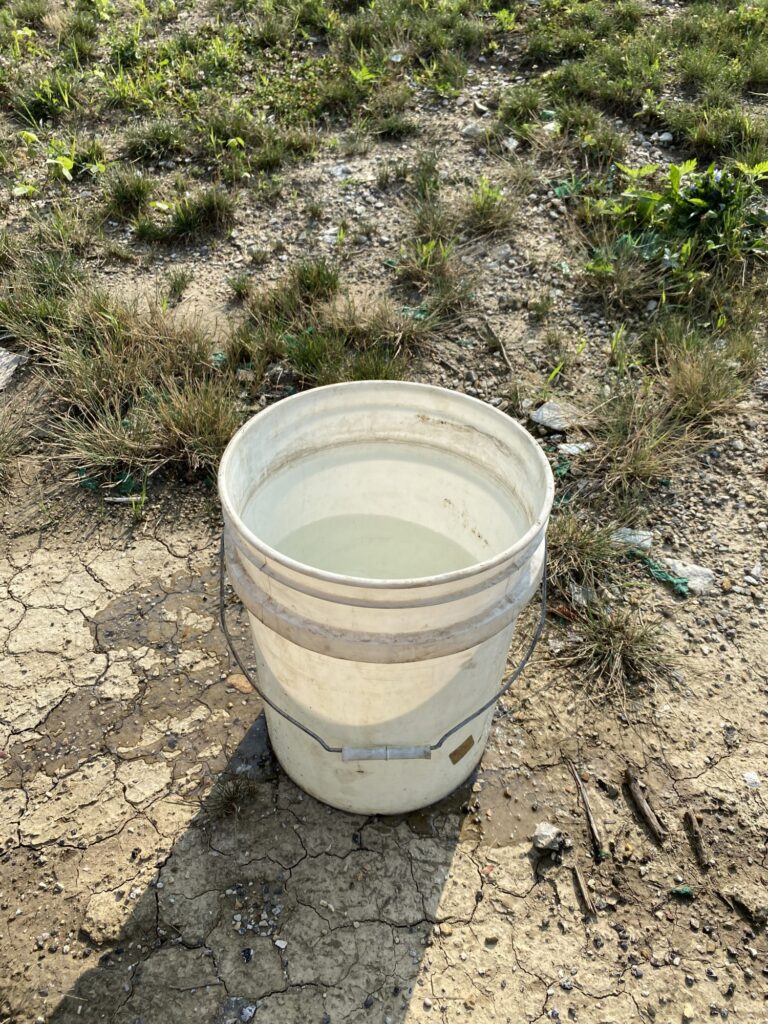
The nice thing about this method is the precision we can achieve. If your tree is 20 inches in diameter, we would fill and relocate the bucket 4 times to get those 20 gallons minimum for our watering rule. If your tree is 10 inches in diameter, a 1 or 2-gallon bucket can be used to make the filling and emptying simple. Alternatively, a 5-gallon bucket can be filled approximately halfway and relocated 4 times to water the tree. The general rule we covered before isn’t set in stone, and going above that minimum a bit won’t endanger the health of your plant.
Additional Considerations
We recommend watering for certain services to maximize their efficiency. Soil-applied insecticides and fungicides will be better absorbed and distributed throughout the tree when given supplemental watering for at least 5 days following application. If you’ve had these services applied to any of your landscape trees or shrubs, following this watering regimen will enhance the efficiency of treatment and provide the best results.
For some tree injections and infusions, applying supplemental watering ahead of time helps maximize chemical uptake and distribution similar to soil-applied chemicals. However, in these circumstances, it’s key to apply watering ahead of service to gain those benefits. Applying supplemental watering at minimum one day before treatment can provide these benefits, but a couple of consecutive days prior is even better. If watering before the service is not possible, supplemental watering any treated trees after service is still beneficial.